


Syllabus: GS3/ Economy/Agriculture, Globalisation and Food Security
Context
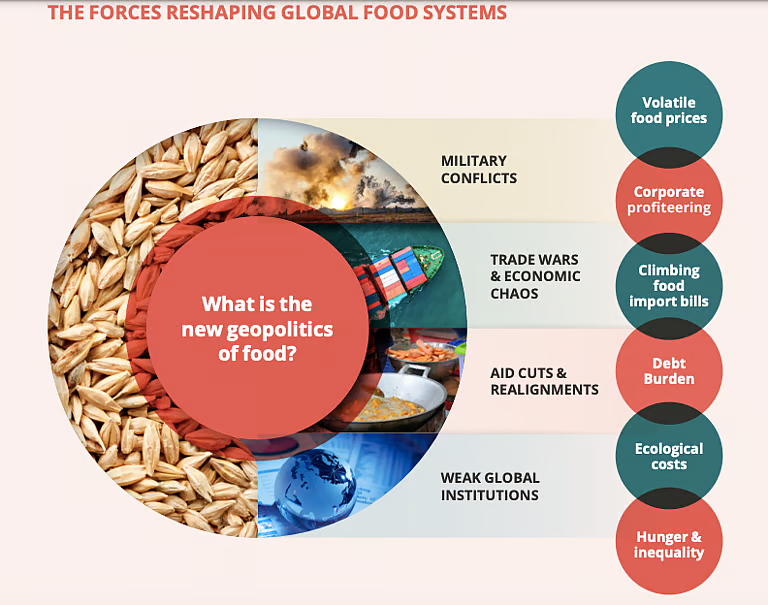
- A report titled The New Geopolitics of Food by the IPES- Food highlights how geopolitical disruptions have enabled large agrifood corporations to earn extraordinary profits, while worsening hunger, food inflation, and environmental degradation, across the world.
Key Findings of the Report
- Corporations Used Crises to Increase Profits: The report argues that several agrifood corporations increased prices beyond actual production cost increases.
- Food inflation after 2020 created opportunities for corporations to raise profit margins.
- Limited competition in food markets enabled dominant firms to exercise pricing power.
- Concentration of Corporate Power: Since 2008, a series of mergers and acquisitions has reduced the number of major seed and agrochemical companies from six to four.
- Several companies reportedly increased fertilizer prices beyond actual production cost, thereby earning higher profits.
Concerns Associated with Excessive Corporate Control
- Threat to Food Sovereignty: Countries may lose control over domestic food systems due to dependence on multinational corporations.
- Price Manipulation: Highly concentrated markets increase the possibility of excessive pricing and profiteering during crises.
- Weakening of Small Farmers: Large corporations often dominate supply chains, limiting bargaining power for small producers.
- Increased Vulnerability to Global Shocks: Overdependence on global trade exposes countries to wars, sanctions, shipping disruptions, and commodity price volatility.
Impact on Developing Countries
- Food Import Dependence: The global food import bill reached approximately US$2.2 trillion in 2025, with the sharpest increases occurring in Least Developed Countries and Net Food Importing Developing Countries.
- Food Inflation: Low-income countries experienced higher food inflation than developed nations because poorer countries have limited fiscal capacity to subsidise food and stabilise prices.
- Rural Poverty and Inequality: Small and marginal farmers continued to face rising input costs, limited bargaining power, and unstable incomes, thereby worsening rural distress and inequality.
- Significance for India: In India public procurement and buffer stock system helped stabilise domestic food prices during earlier global food crises.
- Institutions such as the Food Corporation of India and the Public Distribution System ensured that food grains remained accessible to large sections of the population.
Way Ahead
- Governments should strengthen domestic agriculture through greater public investment, improved irrigation and storage infrastructure, diversified cropping systems, and stronger farmer support mechanisms.
- Countries should revive public food reserves, buffer stock systems, marketing boards, and supply management mechanisms to stabilise food prices during global crises.
- Governments should strengthen competition laws and anti-monopoly regulations to prevent excessive concentration of market power in agrifood sectors.
- Sustainable Agriculture should be promoted through agroecological and climate-resilient farming practices.
- Global Food Governance: International institutions should prioritise food security, fair agricultural trade, debt relief for vulnerable countries, and equitable global food systems.
Source: DTE
Previous article
IMD Launches Block-Level Monsoon Forecast System
Next article
Rural Development in India
